
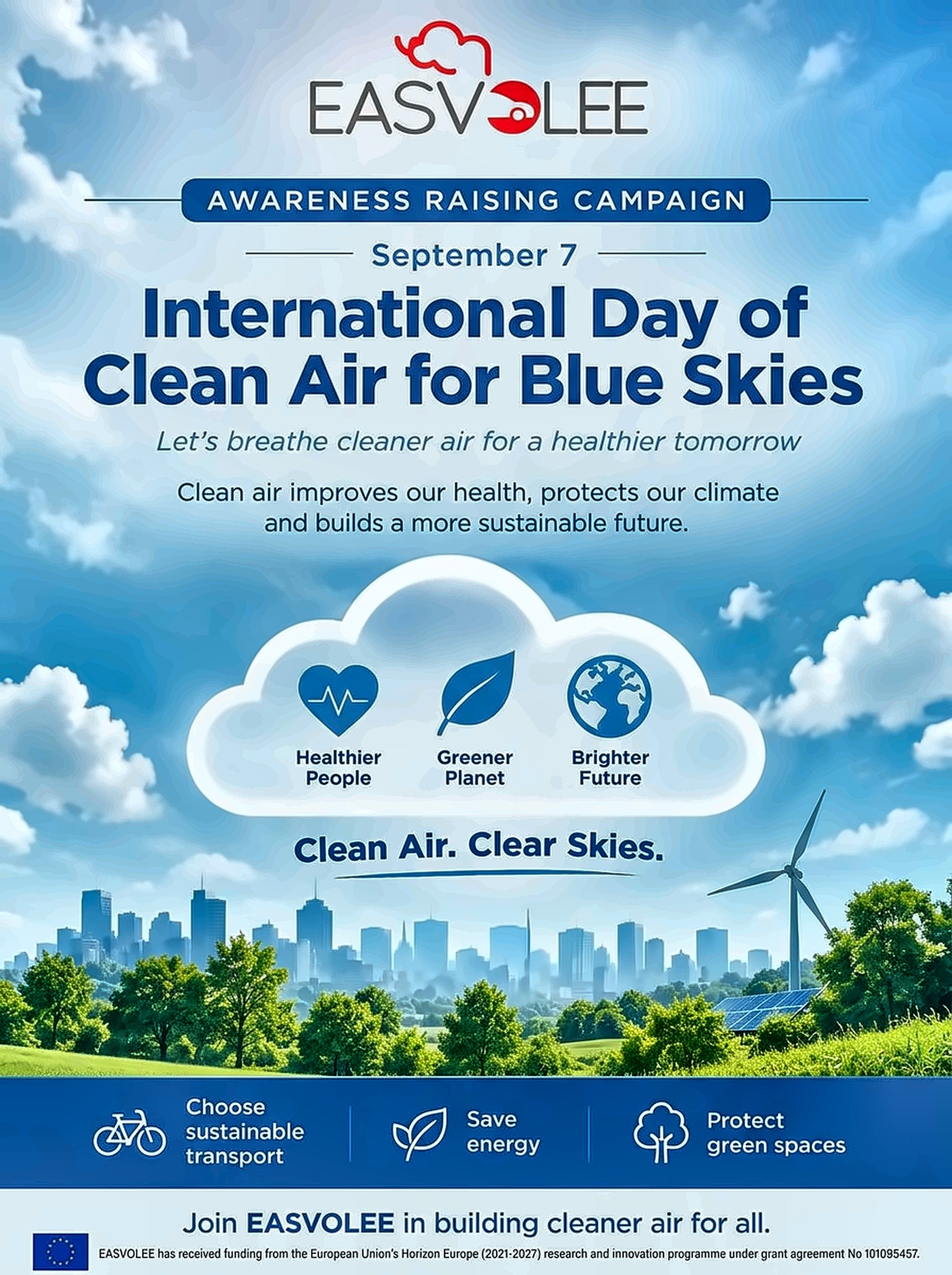
Every 7 September, the United Nations’ International Day of Clean Air for Blue Skies calls on governments, businesses and individuals to accelerate action on air quality and climate together. This year’s observance highlights the economic and public-health case for integrated action — clean air is not only a health imperative, but a foundation for resilient economies and stable climates.
For EASVOLEE, a Horizon Europe-funded research project, this day resonates directly with our core mission. Road transport remains one of the largest contributors to urban air pollution in Europe, but the story does not end at the tailpipe. Vehicle engines emit a wide spectrum of organic compounds — volatile, semi-volatile, intermediate-volatility and low-volatility organic compounds (VOCs, SVOCs, IVOCs and LVOCs) — that continue to react and transform in the atmosphere long after they leave the exhaust pipe. Through oxidation and condensation, these compounds contribute to the formation of secondary organic aerosols: fine particulate matter (PM2.5) that forms downwind of the original emission source, often far from where the vehicle was driven.
This secondary aerosol formation is one of the least understood, and most policy-relevant, pieces of the air quality puzzle. EASVOLEE brings together leading European research groups to measure complete emission profiles from vehicles under real driving conditions — including field campaigns such as our tunnel emissions measurement work — and to trace how these emissions age in the atmosphere, quantify their contribution to PM2.5 and particle number concentrations across seasons, and assess the resulting health effects of both fresh and aged particles.
Why this matters: current air quality regulations largely focus on primary tailpipe emissions. But if a significant share of transport-related PM2.5 forms downstream, in the atmosphere, then policy that only addresses the tailpipe is missing part of the picture. EASVOLEE’s evidence base is designed to close that gap, giving policymakers the metrics they need to design mitigation strategies that address air pollution at its true source, not just its point of emission.
On this International Day of Clean Air for Blue Skies, we’re reminded that blue skies require looking beyond what’s immediately visible. We invite you to follow our research, engage with our findings, and join us in building the evidence base for cleaner air across Europe.
Learn more about our work at easvolee.eu.